Showing posts with label BMW. Show all posts

Thursday, October 4, 2012

BMW i8 Concept Spyder


BMW i8 Concept Spyder

What's most stunning about the BMW i8 Concept Spyder isn't the 350-hp plug-in hybrid technology, the laser-powered headlights or the auto-show touches such as folding electric kickboards. It's that BMW plans to build something with most of these features, in a car looking much like this, within a few years. This is not a dream. Displayed at the Paris Motor Show, the concept wears an exterior that while still futuristic, represents a viable look at what BMW will build in two years. When BMW chief designer Adrian von Hooydonk told the production i8s would strongly resemble the concepts, this -- the layered bodywork, the laser headlights and the tri-tone accents -- was what he meant. Even the i8 Concept Spyder's scissor doors look less showy than purposeful here.

What's most stunning about the BMW i8 Concept Spyder the German automaker isn't the 350-hp plug-in hybrid technology, the laser-powered headlights or the auto-show touches such as folding electric kickboards. It's that BMW plans to build something with most of these features, in a car looking much like this, within a few years. This is not a dream.

Like most auto show concepts, the i8 Concept Spyder moves thanks to a combination of battery and engine -- namely a 96 kW electric motor tied to a 223-hp turbocharged three cylinder engine, for a total output of 354 hp. Unlike most concepts, BMW pledges hard performance targets of 0-60 mph in about five seconds, some 19 miles on electric power alone, a top speed of 155 mph and fuel economy of 94 mpg in European testing.


    The latest evolution of BMW i-Series concepts wears an exterior that while still futuristic, represents a viable look at what BMW will build in two years. When BMW chief designer Adrian von Hooydonk told us in Detroit the production i8s would strongly resemble the concepts, this -- the layered bodywork, the laser headlights and the tri-tone accents -- was what he meant. Even the i8 Concept Spyder's scissor doors look less showy than purposeful here.

Inside, BMW's promising a welter of intelligent software advancements that would anticipate drivers' needs, such warming the batteries before departure or finding charging stations along a route. It claims the batteries can be recharged in under two hours from a standard household outlet, and while at your destination the i8 Concept Spyder has two folding electric kickboards -- essentially Razor scooters with mini motors -- which the automaker touts as "perfect for relaxed cruising along promenades and paths or around city squares."

BMW i8 Concept Spyder


Those won't make it off the auto show floor. But the rest of BMW i8 Concept Spyder appears tantalizingly close, although rumors from Europe suggest the i-Series will match their high goals with high prices, possibly above $100,000. Even then, if BMW can produce something with this performance and design, the future will have a new classic.

Those won't make it off the auto show floor. But the rest of BMW i8 Concept Spyder appears tantalizingly close, although rumors from Europe suggest the i-Series will match their high goals with high prices, possibly above $100,000. Even then, if BMW can produce something with this performance and design, the future will have a new classic.


That kind of performance was made possible by BMW's engineering efforts around the body, mating a carbon-fiber passenger cell to aluminum subframes for the engine and battery. Doing so, BMW claims, allowed it to eliminate the extra weight a plug-in hybrid system usually carries while maintaining the 50/50 front-rear weight split for handling that BMW owners rejoice in. And BMW has programmed the system to choose front, rear or all-wheel-drive as it sees fit.


BMW i8 Concept Spyder

BMW i8 Concept Spyder

BMW i8 Concept Spyder

BMW i8 Concept Spyder

BMW i8 Concept Spyder

BMW i8 Concept Spyder

BMW i8 Concept Spyder

BMW i8 Concept Spyder

BMW i8 Concept Spyder

BMW i8 Concept Spyder

BMW i8 Concept Spyder

BMW i8 Concept Spyder

BMW i8 Concept Spyder

BMW i8 Concept Spyder

Tuesday, August 21, 2012

BMW unveils C evolution electric scooter


Ø  With 11 kW continuous output and 35 kW peak output, the "C evolution" has a powerful motor and    provides a high level of riding fun. The top speed is electronically limited to 120 km/h. The scooter supremely handles motorway riding and overtaking - even with a passenger. It is also capable of effortless hill starts on steep slopes with a pillion passenger. In terms of acceleration from 0 to 60 km/h, it comfortably holds its own against current maxi scooters a capacity of 600 cc or more.

·        The "C evolution" is powered via a drive train swing arm. The alternator is positioned behind the battery casing and integrated in the swing arm.

             Thanks to elaborate power electronics settings, the alternator offers the rider an instant, spontaneous response. There are no delays in torque build-up at all as are typical in combustion engines due to the clutch engaging and disengaging.


      BMW Motorrad has conducted lengthy road tests to develop a form of recuperation which is unique in single-track vehicles and very transparent for the rider.

The charge cable required is housed in a storage compartment on the right-hand side of the footwell. It is fitted with a mains plug to fit the respective national system.

      BMW Motorrad has presented the near-production prototype of the C evolution e-scooter as it might soon go on the market.

One of the main technological challenges was optimum cooling of the high-voltage battery. On the one hand it was necessary to avoid excessively low temperatures due to the fact that the interior resistance of the cells is heavily increased as a result, thereby reducing power

     On the other hand, the temperatures must not be too high since this would impair the lifetime of the cells.

      While in electrically powered cars a cooling agent is normally used to cool the battery, air cooling is used in the "C evolution" in order to save space and weight.

      The heat of the high-voltage battery is dissipated by means of an aerodynamically optimised cooling air shaft at the centre of the battery casing through which there is a constant flow of air. To ensure optimum heat dissipation, the battery base has longitudinally arranged cooling ribs.

     However, the battery casing in die-cast aluminium not only holds the cells with their special architecture but also the entire electronics unit for monitoring the cells. It also acts as a load-bearing chassis element.

      The power electronics for the electric drive is installed behind the battery casing. This not only takes care of controlling the alternator within a range of 100 to 150 volts but also responds to rider commands, for example by detecting the position of the throttle grip.

      The system also processes information from the brake system and decides whether energy should be recuperated and how much recuperation torque is to be applied to the rear wheel if required.

      Innovative electric drive via drivetrain swing arm with liquid-cooled alternator, tooth belt and planetary gear.

      Due to the proximity of the alternator output shaft and the swing arm axle, the moment of inertia around the swing arm centre of rotation is minimised. This also provides optimum suspension/damper settings and a sensitive response.

     The secondary drive is via a tooth belt from the alternator to the rear belt pulley on the output shaft. From here, power is transferred to the rear wheel via a planetary gear. The total gear reduction is 1:8.4, while the maximum rotational speed of the alternator is 10,000 rpm.

     Since it was conceived as a future-oriented vehicle for commuting between the urban periphery and the city centre, there were two particular requirements for its development: performance figures comparable to those of a maxi scooter with a combustion engine and a long range in realistic conditions of use.

The "C evolution" is ridden in exactly the same way as a scooter with combustion engine. The rider does not have to actively initiate energy recuperation since the vehicle does this automatically whenever possible.

      For example, energy recuperation commences when the throttle grip is closed and - as in a combustion engine - the generator function of the alternator creates drag torque which depends on the degree of recuperation.


The drag torque generated by the alternator is like the familiar "engine brake" that takes effect when removing the accelerator with a combustion engine.

Recuperation is also carried out during braking, converting kinetic energy to electrical energy so as to charge the battery. Here, a system of sensors is used to tap into the brake pressure on the front and rear wheel brake.

    When the power electronics detects that the rider is braking, the alternator builds up drag torque, thereby supporting the brake manoeuvre and recuperating energy. By regaining energy during coasting or braking, the range of the two-wheeler can be extended by 10 to 20 per cent, depending on riding style.


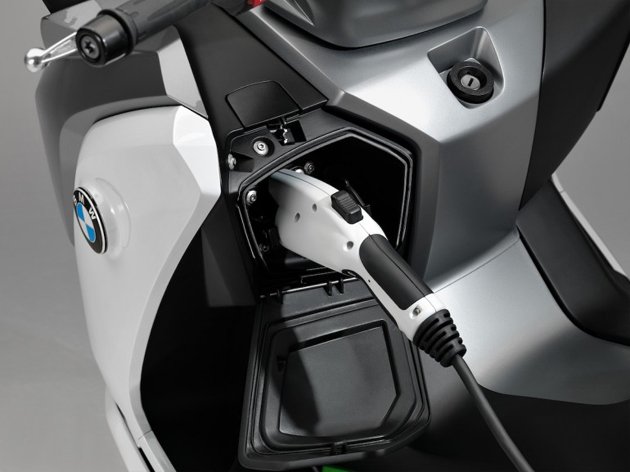
The battery is charged via the integrated charging device, either at a regular household socket or a charging station. When the battery is completely flat, charging time ideally lasts less than three hours.

     The car-type charging socket - currently the only one of its kind in an electrically powered two-wheel vehicle - is located behind a cover in the footwell at front left.


The combined effect of the colour "Light white" and the highlight colour "Electric green" reflects the vehicle's specific properties, such as maximum environmental compatibility, supreme dynamic performance and simple handling. What is more, the illuminating "e" inscription on the two battery side trim elements and motor unit bear out the technical character of an electrically powered scooter.

      With 11 kW continuous output and 35 kW peak output, the "C evolution" has a powerful motor and provides a high level of riding fun. The top speed is electronically limited to 120 km/h.


     The scooter supremely handles motorway riding and overtaking - even with a passenger. It is also capable of effortless hill starts on steep slopes with a pillion passenger. In terms of acceleration from 0 to 60 km/h, it comfortably holds its own against current maxi scooters a capacity of 600 cc or more.


    Compared to conventional combustion engines, the electric drive of the "C evolution" also offers significant advantages at low speeds in particular.


     At 8 kWh, the storage capacity of the battery is extremely generous and ensures a range of up to 100 kilometres. This means that realistic zero-emissions riding in the big city and in urban environments is no problem at all.


    As in other areas, BMW Motorrad has been able to draw on synergy effects with BMW automobiles here. For example, the "C evolution" uses the same lithium-ion storage modules as are installed in the BMW i3.


     Here, developers paid particular attention to the quality and service life of the storage modules so as to ensure that the range is preserved even after many years of service life and in very cold weather.